The Tyler House: John Lautner in Studio City
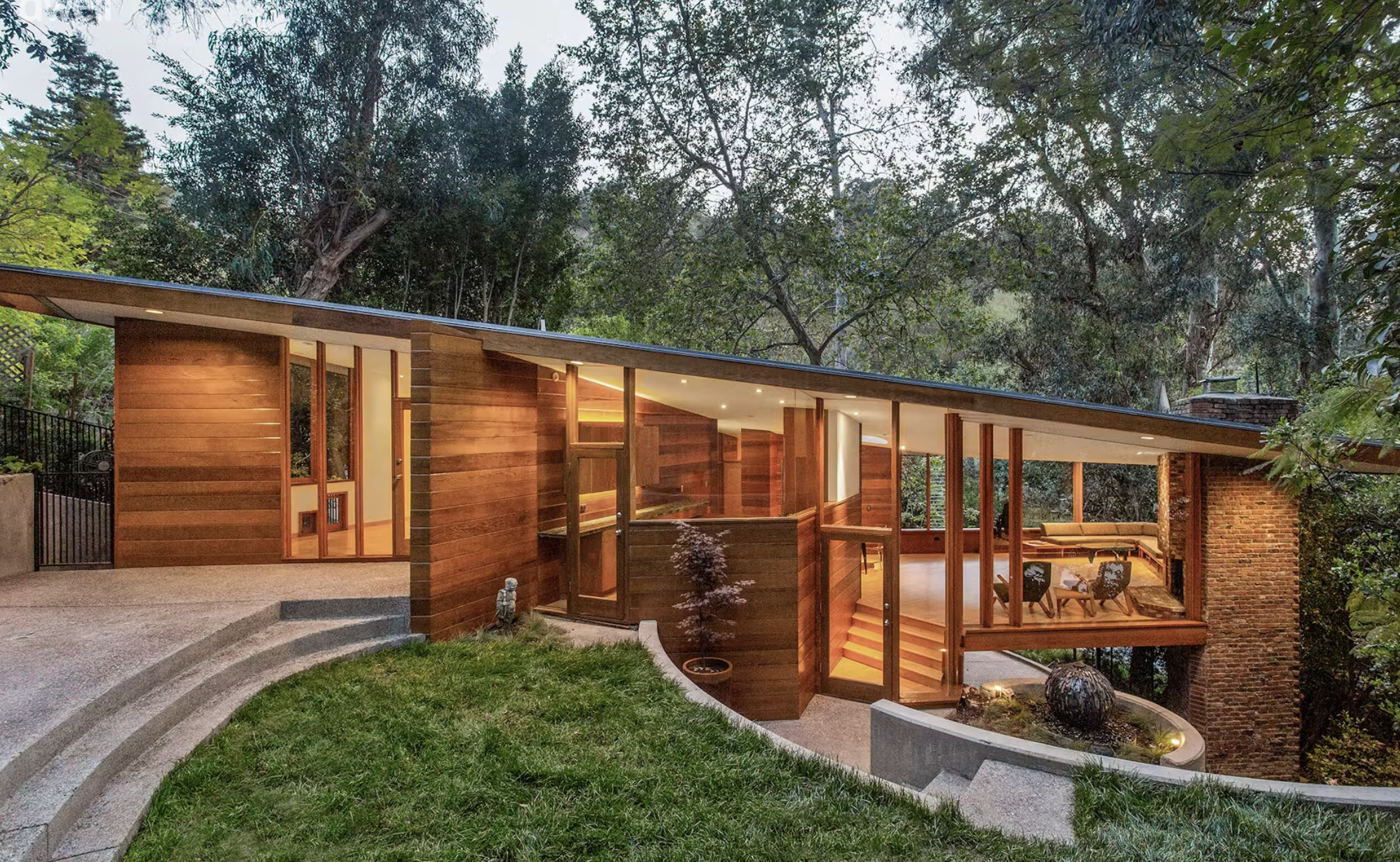
Studio City · Early-Career Lautner
John Lautner's 1950 Tyler House is a rare Valley Lautner from his early practice, an early study in organic architecture that prefigures the dramatic masterpieces to come. Why this hillside home matters, and what it teaches about the Studio City market.
What is the Tyler House?
The Tyler House is a 1950 residence designed by architect John Lautner on a hillside lot in Studio City, an early example of his organic, site-responsive approach to the Southern California home. It is a single-family house notable for the way it works with its sloping site and opens to the landscape, and it has been carefully restored in recent years. It sits at the top of the Studio City market for architectural homes.
1950
John Lautner
Studio City
Slope-Responsive Design
John Lautner is best known for the dramatic, futuristic houses that crown the Los Angeles hills: the Chemosphere, Silvertop, the Sheats House. But the foundation of that genius was laid in quieter homes built earlier in his career, and one of the finest sits on a sloping lot in Studio City: the Tyler House, completed in 1950. It is a rare Lautner in the San Fernando Valley, an early study in the indoor-outdoor, site-driven design that would make him one of the twentieth century's great architects. The full architectural record is on the John Lautner architect profile, which also covers his own house in Silver Lake, the Elrod House in Palm Springs, and the Malin Residence in Malibu. Debbie Pisaro represents architectural homes across Los Angeles, including the design-significant houses of Studio City, and the Tyler House is exactly the kind of property that rewards a buyer who knows what they are looking at.
This profile covers the house, its architect, what makes a Lautner worth seeking out, and how a home like this fits into the Studio City market. It is part of the registry of named Los Angeles homes Debbie Pisaro maintains, tying each significant house to its architect and its story, from the Silver Lake architecture guide to the architectural archive.
Built at the right time, on the right slope
Built at the start of the 1950s, the Tyler House belongs to the period when Lautner was translating the lessons of his apprenticeship with Frank Lloyd Wright into a distinctly Californian language. Rather than imposing a box on the hillside, he let the slope shape the house, an approach that produced homes far more dramatic and livable than the flat-lot tract houses going up across the Valley at the same time. This is the same design philosophy that would lead, eight years later in 1958, to the house he built for himself in Silver Lake, and later still to masterworks like the Chemosphere and Silvertop. The home was restored in recent years and has come to market as a private residence, which places it squarely in the living architectural market rather than the museum case.
The early-career Lautner principle
John Lautner was one of the most influential American architects of the twentieth century, celebrated for organic, structurally daring homes that fused dramatic engineering with deep sensitivity to site. A former apprentice of Frank Lloyd Wright, he spent his career in Los Angeles, where his houses—from the Chemosphere to Silvertop, from Sheats House to the Elrod House—became icons of California modernism.
Lautner trained under Wright at Taliesin before establishing his own Los Angeles practice, and he carried Wright's organic philosophy in a bolder, more engineered direction. His best-known works are gravity-defying showpieces, but the through line across his career was an insistence that a house belong to its site and serve the life lived inside it. That is why an early, comparatively restrained work like the Tyler House matters: it shows the principles before the spectacle. The Tyler House came in the middle of his early practice, after his own residence in Silver Lake and well before the international commissions that made him famous.
Lautner did not put a box on the hill. He let the hill shape the house.
What is the Tyler House like as architecture?
The Tyler House reflects the hallmarks of Lautner's residential work: a structure shaped by its sloping site, a strong connection between interior space and the landscape outside, and the honest use of materials and structure as the architecture itself rather than as something to be hidden. It is restrained compared with his later spectacles, but it is recognizably his.
Where a conventional builder of 1950 would have cut and filled the lot to create a flat pad, Lautner did the opposite, designing the house around the grade so that the slope becomes part of the experience of moving through it. The result is the indoor-outdoor continuity that California modernism promised and that Lautner delivered better than almost anyone, rooms that open to terraces, views, and light, with the structure left expressive rather than concealed behind ornament. These are the qualities that separate a genuine architect-designed home from a merely large one, and they are why a Lautner reads as art the moment you step inside.
For a buyer, that design intelligence is also what protects the home's value over time, because it does not date the way a fashion-driven renovation does. A well-conceived Lautner from 1950 still feels modern today, which is the surest sign that the architecture was right in the first place.
Why is a Lautner worth seeking out?
A John Lautner home is worth seeking out because his houses are scarce, instantly recognizable, and among the most coveted modern residences in the world, which gives them exceptional desirability and resilience. Owning a Lautner means owning a documented work by a master, the kind of provenance that sets a home apart from anything new construction can offer.
Lautner did not build many houses, and each is distinct, so the supply is fixed and the demand among collectors and design-driven buyers is deep and international. That combination is the foundation of value for any significant architectural home, and it is especially strong for an architect of Lautner's stature. A Lautner in Studio City also carries the advantage of the Valley's relative value compared with the Westside and the hills, which can make a genuine masterwork more attainable than its equivalent in Beverly Hills or the Bird Streets. Debbie Pisaro prices homes like this on exactly those terms, on architect, integrity, and the depth of the buyer pool rather than a generic per-foot figure.
For the design-minded buyer, the Tyler House also sits within one of the most quietly architectural pockets of the city. Studio City has a deep stock of significant modern homes, and architectural pedigree matters here. The full architectural homes archive tracks the breadth of Lautner's work across Los Angeles and beyond, from the Lautner's Own House to the Malin Residence in Malibu.
What should a buyer know about owning an architectural home like this?
A buyer of a Lautner or comparable architectural home should understand that its value lives in its original integrity, that sensitive restoration protects that value while heavy alteration destroys it, and that these homes reward an owner who sees themselves as a steward. Specialized care and the right contractors matter, but so does the simple discipline of preserving what the architect intended.
The cardinal rule with a home like the Tyler House is that originality is the asset. A buyer tempted to gut and modernize a Lautner would be erasing the very thing that makes it valuable, the opposite of the instinct that serves an ordinary house. The recent restoration of the Tyler House is a model of the better path: repairing and honoring the design rather than overwriting it. Debbie Pisaro guides buyers of architectural homes through that mindset, and through the practical questions of condition, systems, and the specialized trades these houses require. The reward is ownership of something genuinely irreplaceable.
With a Lautner, the renovation you should plan for is restoration, not reinvention. The home's value is in what the architect drew. Protect it, and you protect the asset.
How does the Tyler House fit the Studio City market?
The Tyler House sits at the top of the Studio City architectural market, a neighborhood that pairs genuine design pedigree with relative value compared to the Westside and the hills. A documented Lautner is the rare kind of home that draws design-driven buyers from across the city and beyond, while still benefiting from the Valley's more accessible pricing.
Studio City has long attracted people who work in the entertainment industry and want substance over flash, which has quietly seeded the neighborhood with significant modern homes. That gives a house like the Tyler House two audiences at once: local buyers who know and value the area, and architecture collectors who would buy a Lautner anywhere. Debbie Pisaro has sold significant modern homes in Studio City, including a Schindler, and she understands how to position a true architectural work for both of those pools rather than listing it as just another hillside house. The result, done right, is a sale that reflects what the home actually is. For a buyer, it means the chance to own a genuine work of architecture in a neighborhood that still rewards the search, and for a seller, it means a marketing strategy built around the architect's name and the home's design rather than a generic comparison to the house down the block.
The Tyler House, answered
Where is the Tyler House?
The Tyler House is located in Studio City, in the San Fernando Valley area of Los Angeles, built on a sloping hillside lot that became central to Lautner's design strategy. It is one of the relatively few John Lautner residences located in the Valley rather than the hills above the basin, which makes it architecturally and geographically distinctive in the context of his career and practice.
Who designed the Tyler House?
Architect John Lautner designed it in 1950, early in his independent Los Angeles practice. It is a formative work rather than a famous one, and it shows the organic, site-driven principles he would later push to dramatic extremes in the houses that made his name, the Chemosphere and Silvertop among them.
When was the Tyler House built?
It was completed in 1950, during the early years of Lautner's independent Los Angeles practice. That places it after his apprenticeship with Frank Lloyd Wright at Taliesin and well before the commissions that made him internationally known, which is part of why it reads as quieter and more restrained than the houses most people picture when they think of his name.
What makes John Lautner's homes so valuable?
Scarcity and stature together create lasting value. Lautner built relatively few houses, no two alike, and they sit among the most coveted modern residences anywhere in the world. A fixed supply meeting deep international demand is what gives them their unusual resilience and desirability, and it is why provenance and architectural integrity matter more here than square footage does.
Is the Tyler House a good investment?
A documented Lautner in good original condition has tended to hold its value well, though that is general information rather than investment advice and every house differs. What actually drives the number is architectural integrity, condition, how it is priced, and how deep the buyer pool is on the day. These homes reward preservation over alteration, and a buyer should understand that conservation is the strategy that protects value.
Are there many architectural homes in Studio City?
Yes, and it is one of the neighborhood's defining characteristics. Studio City has a deep stock of significant modern homes, including works by R.M. Schindler and John Lautner, which is why it is one of the more quietly architectural neighborhoods in Los Angeles. That concentration means a Lautner anchors that story at the top, and a buyer here has the advantage of neighborhood-wide design pedigree.
Should you renovate a Lautner house?
Only with real restraint and respect for the original design. Originality is the asset in a Lautner, so the right approach is sensitive restoration that reads the design and works with it, never a gut renovation that erases what the architect created. Heavy alteration destroys exactly the thing a buyer at this level is paying for, and it is difficult and expensive to undo afterwards.
How does a Valley Lautner compare in price to one in the hills?
Studio City and the Valley have generally offered relative value compared with the Westside and the hills, which can make a genuine Lautner more attainable than an equivalent in Beverly Hills or the Bird Streets. However, each home is unique and should be valued individually based on condition, provenance, and market demand at the time of sale. See the house John Lautner built for himself for pricing context on early-career Lautners.
Where can I learn about other Lautner homes in Los Angeles?
A full catalog of John Lautner's Los Angeles residences is available, including his own house in Silver Lake, the Chemosphere, Silvertop, the Sheats House, the Elrod House, and the Malin Residence.
For Studio City Buyers and Sellers
Buying or selling an architectural home in Studio City?
Debbie Pisaro represents buyers and sellers of modern and architecturally significant homes across Studio City and the Valley.
Reach DebbieDebbie Pisaro, DRE #01369110, is the founder of Coastline 840, a 24-year veteran of the California market, and a 2025 Inman Luxury Leader. She represents buyers and sellers of architectural and design-forward homes across Studio City, greater Los Angeles and the wider state, and writes about the neighborhood at juststudiocity.com. DRE #01369110 · Coastline 840